

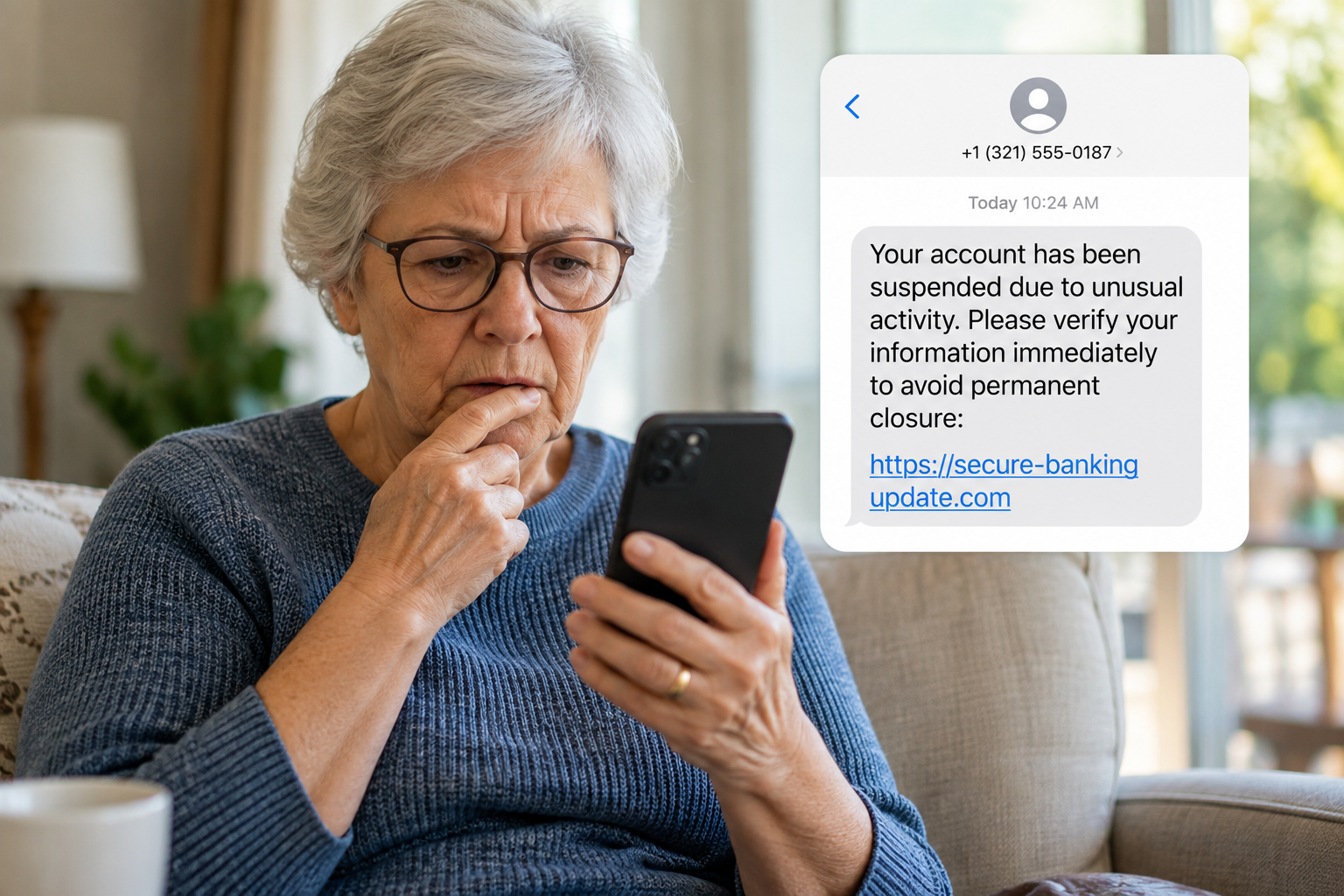
Imagine getting a text from your bank while you're having your morning coffee:
“Did you authorize this $2,847 purchase? Reply YES to confirm or call this number immediately.”
Related Page: HOW TO KNOW IF YOUR BANK ACCOUNT HAS BEEN HACKED
You don't recognize the purchase. The message looks legitimate. The phone number appears familiar. And because it involves your bank, you react quickly.
That's exactly what the scammer wants.
Bank impersonation scams have become increasingly sophisticated, using text messages, phone calls, emails, fake websites, caller ID spoofing and even convincing-looking security alerts to make criminals appear legitimate. According to the Federal Trade Commission, people reported losing $3.5 billion to imposter scams in 2025, with bank impersonators accounting for the highest reported losses among business impersonation scams.
The goal isn't simply to convince you that there's a problem with your account. It's to make you trust the person contacting you enough to give them the information or access they need to steal your money.
At Liberty Savings Bank, we believe financial security starts with knowing what to watch for. Here's how bank impersonation scams work, why they're so convincing, and what you should do if someone claiming to be your bank contacts you unexpectedly.
What Is a Bank Impersonation Scam?
A bank impersonation scam occurs when a criminal pretends to be your bank, credit union, financial institution, or even a bank employee in an attempt to steal your money or sensitive information.
The scammer may claim to be calling from:
- Your bank's fraud department
- The bank's security team
- Online banking support
- The debit card department
- A branch near you
- The bank's technology department
They may contact you through a:
- Phone call
- Text message
- Social media message
- Fake website
- Search engine advertisement
- Pop-up security alert
The Federal Deposit Insurance Corporation (FDIC) specifically warns that criminals may impersonate banks and ask for information such as Social Security numbers, debit or credit card numbers, account passwords or other sensitive financial information.
The scam often begins with a simple message: There's a problem with your account.
From there, the pressure begins.
Why Do Scammers Pretend to Be Your Bank?
Your bank already has your trust
This is the biggest reason.
You already expect your bank to contact you about suspicious transactions, account security and other financial matters. A message from someone claiming to be your bank doesn't immediately seem unusual.
Scammers take advantage of that existing trust.
Instead of convincing you to trust a completely unknown person, they only need to convince you that they're someone you already trust.
Fear makes people act quickly
Scammers don't want you to stop and think.
They want you to feel:
- Worried
- Confused
- Rushed
- Afraid of losing money
- Concerned that your identity has been stolen
A message saying “Your account may be compromised” creates an emotional reaction. Once you're worried about your money, you may be more likely to click a link, call a number, provide a verification code or follow instructions without independently confirming who you're talking to.
The Consumer Financial Protection Bureau identifies urgency, requests for personal information and impersonation of trusted organizations as classic warning signs of fraud.
Banks are associated with large amounts of money
Scammers know that your bank account may contain your paycheck, savings, retirement funds or money you've set aside for major expenses.
That makes bank customers particularly valuable targets.
And scammers don't necessarily need your entire account number to cause damage. They may be trying to obtain your online banking credentials, debit card information, security codes or other pieces of information that can help them gain access to your accounts.
How a Bank Impersonation Scam Usually Works
One of the most convincing aspects of these scams is that they're often designed as a sequence rather than a single message.
Here's an example.
Step 1: You receive a fake fraud alert
You get a text message:
“Liberty Savings Bank Fraud Alert: Did you attempt a $2,400 purchase? Reply YES or NO.”
You don't recognize the transaction.
Step 2: You respond
You reply that you didn't authorize the purchase.
Now the scammer knows they have your attention.
Step 3: The scammer calls you
A few minutes later, someone calls claiming to be from your bank's fraud department.
They may already know your name, the last four digits of a card, or other basic information.
That makes the call feel even more legitimate.
Step 4: They create a sense of urgency
The caller tells you:
“Someone is attempting to access your account, and we need to secure it immediately.”
Then they begin asking questions.
Step 5: They ask for sensitive information
The scammer may request:
- Your online banking username
- Your password
- Your debit card number
- Your Social Security number
- A one-time verification code
- Your PIN
- Personal information used to verify your identity
They may even ask you to move money to another account to “protect” it.
Step 6: They use the information against you
Once the scammer has enough information, they may attempt to access your accounts, make unauthorized transactions, open accounts in your name or commit identity theft.
The FDIC has warned about this exact type of scam, including situations where a fake text is followed by a phone call from someone pretending to work in a bank's fraud department.
Common Types of Bank Impersonation Scams
Bank impersonation doesn't always look the same. The details change constantly.
The underlying strategy usually doesn't.
Fake bank fraud alerts by text
This is sometimes called smishing, a form of phishing that uses text messages.
You may receive a message claiming that:
- A suspicious purchase was detected
- Your debit card has been locked
- Your account needs verification
- Your password has expired
- Your account has been compromised
- A payment is pending
- Your account will be closed
The message may include a link or phone number.
Don't click the link. Don't call the number in the message.
Instead, contact your bank through a trusted phone number or official website.
The FDIC specifically recommends calling your bank using a phone number you already know, such as the number on your debit or credit card.
Fake bank phone calls
This type of scam is sometimes called vishing, or voice phishing.
The caller may sound professional and knowledgeable. They may use banking terminology and claim to be part of the fraud department.
Caller ID isn't proof that the call is legitimate.
Scammers can manipulate caller ID information to make a phone number appear to belong to a familiar organization. The FTC warns consumers not to rely on caller ID alone when determining whether someone is legitimate.
Fake bank emails
Phishing emails can look remarkably similar to legitimate bank communications.
They may include:
- Bank logos
- Brand colors
- Professional-looking layouts
- Links to fake login pages
- Security warnings
- Familiar terminology
The goal is usually to get you to click a link and enter your credentials.
Before clicking anything, ask yourself:
Was I expecting this message?
If not, go directly to your bank's website or mobile app instead of using the link in the email.
Fake bank websites
Some scammers create entire websites designed to look like legitimate financial institutions.
A fake website may contain a familiar bank name, logo or even fraudulent use of the FDIC name or “Member FDIC” logo.
The FDIC recommends verifying that a bank is legitimate through its BankFind Suite and carefully comparing the institution's name with the actual website address.
7 Warning Signs a “Bank” Message May Be a Scam
1. They're pressuring you to act immediately
“Act now.”
“Your account will be closed.”
“Someone is stealing your money.”
“Stay on the phone.”
Urgency is one of the most common tools scammers use.
A legitimate financial institution understands that protecting your account is important. You should still have time to independently verify who is contacting you.
2. They're asking for your password
Your online banking password should remain private.
If someone unexpectedly calls, texts or emails asking you to provide your password, stop the conversation.
3. They're asking for a one-time verification code
This is a particularly important warning sign.
A scammer may tell you they're sending a security code to confirm your identity. In reality, the code may be part of an attempted login or transaction.
Giving the code to the scammer can help them complete the action they're attempting.
Never share a security code with someone who contacted you unexpectedly.
4. They're asking you to move your money
This is a major red flag.
Someone claiming to be from your bank may tell you to transfer money to a “secure” account because your current account has been compromised.
Don't do it.
The CFPB warns that legitimate financial institutions and government agencies do not tell consumers to send money to “protect it.”
5. They're telling you to use an unusual payment method
Be especially cautious if someone claiming to be your bank asks you to use:
- Cryptocurrency
- Gift cards
- Cash
- Wire transfers
- Payment apps
These payment methods can be difficult to reverse or recover.
6. The message contains a suspicious link
Don't assume a link is safe because the message looks professional.
Instead, open your bank's official app or manually enter the bank's known website address into your browser.
7. Something simply feels off
Trust your instincts.
Maybe the message uses unusual language. Maybe the phone number looks strange. Maybe the caller is overly aggressive. Maybe they're asking for information your bank normally wouldn't request.
You don't have to prove it's a scam before hanging up.
You can simply stop and verify.
What Should You Do If Someone Claiming to Be Your Bank Calls?
Stop. Hang up. Verify.
That's the simplest rule to remember.
If someone unexpectedly contacts you about suspicious activity, take these steps.
Step 1: Don't provide information
Don't give the caller your:
- Password
- PIN
- Full debit card number
- Social Security number
- Security code
- Online banking credentials
Don't confirm sensitive information simply because the caller already knows some details about you.
Step 2: End the conversation
You don't need to argue with the caller.
Simply say that you'll contact the bank directly and hang up.
Step 3: Contact your bank independently
Use a trusted phone number.
For Liberty Savings Bank customers, you can contact our FreedomLine at 800-436-6300 or use the contact information on our official website.
You can also access your account through our official online and mobile banking channels rather than clicking a link provided in an unexpected message.
Step 4: Check your account
Review recent transactions and look for anything you don't recognize.
If you notice an unauthorized transaction or suspicious activity, contact your financial institution as soon as possible.
Liberty Savings Bank's online banking agreement also instructs customers to notify the bank immediately if their statements show transfers they did not make.
Step 5: Change compromised credentials
If you gave a scammer your online banking password or another sensitive credential, contact your bank immediately and follow its instructions.
Change passwords that may have been compromised, particularly if you reused that password elsewhere.
Step 6: Report the scam
If you've lost money or provided personal information to a scammer, don't be embarrassed.
Report the incident.
The FTC accepts reports at ReportFraud.ftc.gov, while suspected internet crime can also be reported through the FBI's Internet Crime Complaint Center. The CFPB recommends contacting your financial institution as well as appropriate federal, state or local authorities when you believe you've been targeted.
What Your Bank Will and Won't Ask For
One of the best ways to protect yourself is to understand what legitimate communication should look like.
Your bank may contact you about suspicious activity. That part is real.
But an unexpected contact asking you to reveal passwords, authentication codes or other sensitive credentials should immediately raise questions.
When you're unsure, don't try to determine whether the person is legitimate while you're on the phone with them.
Verify independently.
For example, instead of saying:
“Can you prove you're really from my bank?”
Simply say:
“I'll call the bank directly.”
Then use a trusted phone number.
That's safer because a sophisticated scammer may have answers prepared for your questions.
What If You Already Gave a Scammer Information?
First, don't panic.
Act quickly.
If you gave them your banking credentials
Contact your bank immediately and explain exactly what information you provided.
Follow the bank's instructions for securing your account.
If you gave them a debit or credit card number
Contact your financial institution or card issuer immediately. Ask what steps should be taken to protect the card and account.
If you gave them your Social Security number
Consider additional identity-theft protections, including monitoring your credit and reviewing guidance from trusted government resources.
If you sent money
Contact the financial institution or payment provider used to send the money as quickly as possible. Depending on the payment method and circumstances, there may be steps that can be taken to attempt recovery.
The important thing is not to wait because you're embarrassed.
Scammers want victims to stay quiet.
Getting help quickly gives you the best opportunity to limit additional damage.
How Families Can Help Older Adults Avoid Bank Scams
Scammers frequently target older adults with impersonation schemes because the potential financial losses can be significant.
The FTC reported a sharp increase in reports involving impersonation scams that resulted in older adults losing tens or even hundreds of thousands of dollars.
But protecting a parent, grandparent or other loved one doesn't have to mean taking over their finances.
Start with a conversation.
Talk about common scams. Explain that caller ID can be spoofed. Make sure they know that it's okay to hang up and call the bank themselves.
Most importantly, remove the stigma around being targeted.
Scams are designed to deceive people. Falling for one doesn't mean someone is careless or unintelligent.
It means the scam was designed to work.
The more comfortable people feel talking about suspicious calls and messages, the easier it becomes to stop a scam before money is lost.
How to Make Bank Impersonation Scams Less Effective
You don't need to become a cybersecurity expert to protect yourself.
A few simple habits can make a significant difference.
Save your bank's phone number
Keep your bank's official phone number in your contacts or know where to find it on your debit card.
That way, you don't have to search for a number while you're worried about a suspicious transaction.
Use your bank's official app or website
Rather than clicking links in unexpected messages, open your banking app yourself or type your bank's known web address into your browser.
Turn on account alerts
Account alerts can help you spot transactions and account activity you don't recognize.
Use strong, unique passwords
Don't reuse your online banking password for email, social media or other websites.
Enable multifactor authentication
When available, multifactor authentication adds another layer of protection to your accounts.
Talk about scams with your family
This may be one of the most effective steps of all.
Tell your spouse. Talk to your parents. Explain common scams to your children.
Scammers rely on secrecy and urgency.
Conversation takes away both.
The Most Important Rule: Slow Down
The biggest advantage a scammer has is momentum.
They want you to react before you think.
That's why one of the best fraud-prevention tools isn't a piece of software or a complicated security system.
It's simply time.
If a message says your money is in danger, don't let the message dictate what you do next.
Take a breath.
Close the text.
Hang up the phone.
Open your bank's official app.
Call a trusted number.
Verify what's actually happening.
That small pause can make a huge difference.
We're Here to Help You Protect Your Money
At Liberty Savings Bank, we believe banking is about more than accounts and transactions. It's about relationships.
When something looks suspicious, you shouldn't have to figure it out alone. If you're a Liberty customer and receive a message or call that you're unsure about, contact us directly using a trusted phone number rather than responding to the unexpected communication.
You can also visit our official website or review our online and mobile banking resources to make sure you're using legitimate banking channels.
And remember: A legitimate bank will never be offended because you took a moment to verify who you were talking to.
In fact, we encourage it.
Scammers may be getting more sophisticated, but staying informed, slowing down and knowing how to reach your bank directly can go a long way toward protecting your money — and helping protect the people in your community, too.
Trusted Resources for Fraud Prevention
For additional information and current guidance, we recommend these resources:
- Federal Trade Commission: How to Avoid Imposter Scams
- FDIC: Bank Impersonation Scams and Fake Banks
- Consumer Financial Protection Bureau: Fraud and Scams
- FBI Internet Crime Complaint Center — for reporting suspected internet crime.